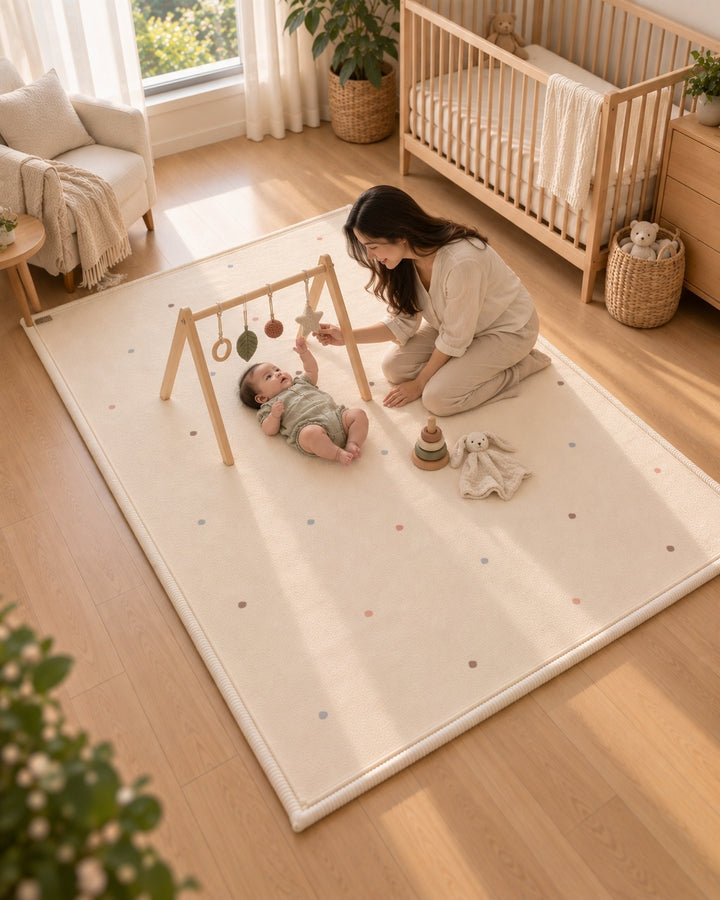
Why we designed our own playmat
We spent the better part of a year on our home before Natalie could walk.
Not in a grand way. Singapore apartments do not really allow for grand. But we cared about it more than was probably reasonable: the floor finish, the door handles, where the light landed on the wall at five in the afternoon, the two or three colours we let into the living room and the many we quietly kept out. Hundreds of small decisions over months. By the end it was the room we wanted.
Then our daughter started crawling, and we went looking for a playmat.
What was actually on the market
You already know what we found, because you have probably found it too.
Primary red, primary yellow, primary blue. Alphabets printed edge to edge. Cartoon animals in mid wave. Interlocking foam tiles in the exact shade of a childcare centre, sold in packs of nine, curling at the corners within a month. Reversible mats with a road map on one side and a jungle on the other, so that whichever way you laid it down, it shouted.
The calmer options were calmer because they were thinner. Two or three millimetres of plastic that rolled up at the edges and offered almost nothing underfoot.
What struck us was the assumption sitting underneath all of it: that once a child arrives, the room stops being a room you designed. That you get the home you love, or you get the floor your child needs, and the polite thing to do is pack the first one away for a decade.
We did not want to accept that, and we did not think anyone should have to.
What we wanted from a playmat instead
So we wrote down what we actually needed, which turned out to be a short and fairly stubborn list.
- Genuinely cushioned underfoot, without being so thick it becomes a step in the room.
- Big enough for real play, so that a child is not constantly rolling off the edge of it.
- Calm enough that we would leave it out when friends came over.
- A surface soft against skin, and one that takes a spill without drama.
- An edge that looked finished rather than raw foam in a plastic sleeve.
- Something that stays put on Singapore tile and vinyl.
Nothing we could find did all six. So we spent the next stretch of months finding a factory that would make one properly, and we paid for the version we wanted rather than the version that was cheap.
The materials, and why each one is there
A playmat is a piece of furniture. We wanted to be able to say exactly what is in ours.
30 mm of high-density slow-rebound memory foam. This is the expensive part and the reason the mat exists. It compresses slowly under weight instead of bouncing, so a jump lands without a sound. It is also dense enough that an adult can sit on it for an hour and get up again without complaint, which matters more than anyone tells you before they have a child.
A brushed flannel surface. Soft against skin, matte rather than shiny, and water-resistant, so the usual milk and juice and yoghurt lift away with a damp cloth. The flannel is certified to OEKO-TEX Standard 100, Class I, the class written for articles used by babies and toddlers. That is the basis for calling the brushed flannel surface baby-safe, and we keep the claim to the surface it was tested on.
A corduroy bound edge, sewn. Purely a design decision, and the detail we are most attached to. It gives the mat a finished border in the same way a rug has a binding, and it is the reason the mat reads as an object in the room rather than a piece of equipment in it. The border is 30 mm wide on all four sides.
An anti-slip TPR backing. Singapore floors are hard and smooth. The backing grips without adhesive and without leaving anything behind.
One piece, permanently sewn. There is no removable cover, which was deliberate. Removable covers mean zips, seams and a wrestling match every few weeks, and a gap for crumbs to live in. We would rather give you a surface you can wipe.
The finished mat is 150 × 200 cm. Large enough to be the floor of the room, not a mat placed on it.
Two designs for the same floor
We drew the patterns ourselves, and we drew them small.
Tumble No. 01 · Scribble is a single Clay line looping across Off-White. It is the first mark a child makes, drawn cleanly enough to live in a living room. It is the one we have at home.
Tumble No. 02 · Confetti scatters that idea into dots of Clay, Mist and Blush on Off-White. A little more play, for a room that is mostly theirs.
Two moods, one floor. Both are made for the years the floor is shared.
A few things people ask
Why 30 mm, and is thickness the thing to shop on? Not on its own. What the foam is made of changes how it behaves, and slow-rebound foam compresses gradually rather than springing back, so 30 mm of it feels nothing like 30 mm of cheap EVA. We chose 30 mm because it gives us that cushioning while keeping the mat low enough to sit flat in a room adults walk through.
Does it slide on tiles? The TPR backing grips bare tile and vinyl. A new mat needs one to two days flat on the floor to settle out of its packing folds, and it will look its best after that.
How do you clean it? A damp cloth for everyday spills, and nothing in the machine, because it is a single sewn piece. Full instructions live on our care page.
We hope you enjoy it as much as we do
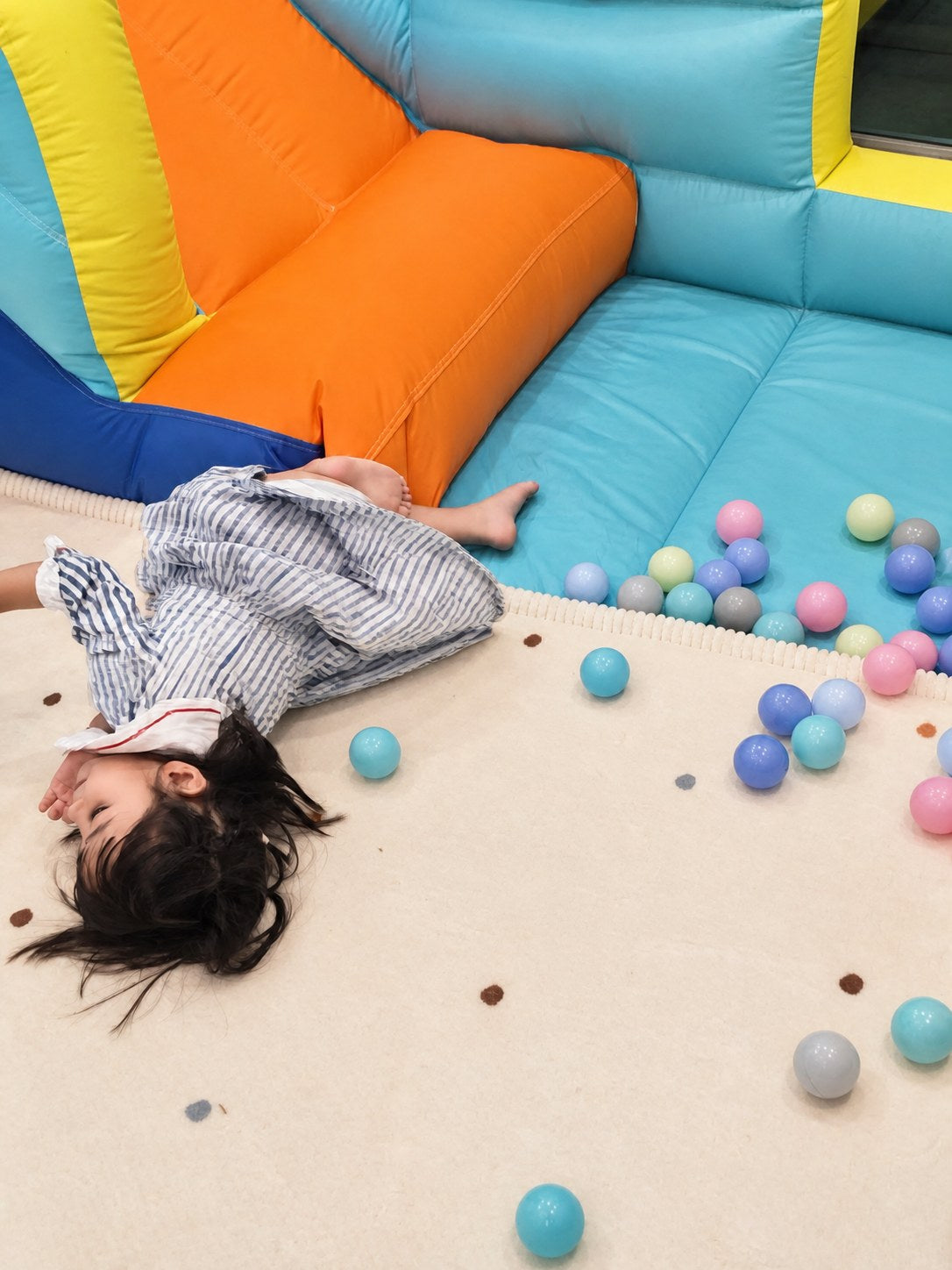
Ours has been on the floor of our living room for a while now. It has been a racetrack, a picnic, a stage and a landing pad. It has taken a yoghurt incident we will not describe. It still looks like something we chose.
That is the whole ambition, really. Not to make childhood smaller or quieter or more tasteful than it is, because it is none of those things and should not be. Just to make the surface underneath it something you are glad to see when you walk into the room.
For the loud years.
More about why we started Maison Mayhem, or see the mats in real homes.
the tumble series
Scribble and Confetti baby play mats: 150 x 200 cm, 30 mm memory foam, free delivery in Singapore.